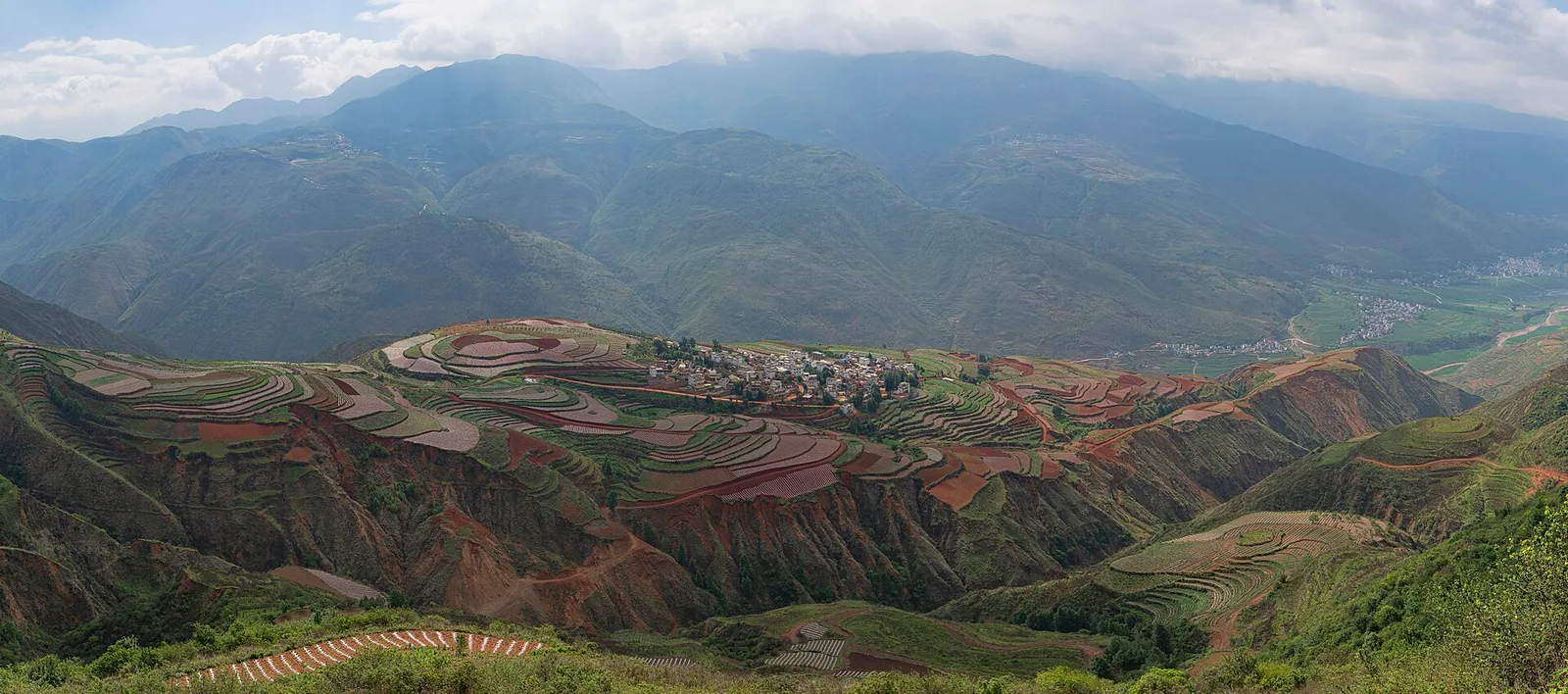
Dongchuan's Red Land is a highland farming area northeast of Kunming where the soil is intensely red, the fields are patchworked with wheat, potato, and buckwheat, and the light changes the colour of everything. It became famous through photography, and it remains a landscape rather than an attraction: there are viewpoints, but no gates, no ride, and no interpretation centre.
What you are looking at
The red colour comes from iron oxide in the soil, typical of parts of Yunnan's plateau. Farmers work small plots on steep slopes, rotating crops that flower in different colours through the year. In spring, green wheat and white potato flowers contrast with the red earth; in autumn, buckwheat and other crops add pink and gold. The effect is best after rain, when the soil is saturated and the colours deepen.
The main viewpoints — Luoxiagou, Damakan, Jinxiu Yuan, and the area around Huashitou — are spread along a road that winds through the hills. Sunrise and sunset are the classic times, but the middle of the day can also be dramatic when clouds cast shadows across the slopes.
- Luoxiagou and Damakan viewpoints
- Huashitou village and its white-walled houses
- Farm tracks between fields, walked with permission
- Seasonal crop colours, which change through the year
Getting there and getting around
The area is about 3–4 hours by road from Kunming, or a stop on the road toward Huize. Public transport is limited; most visitors hire a car and driver for the day or stay overnight in a local guesthouse. The roads are narrow and can be foggy; a local driver is worth the cost.
There is no single ticket or visitor centre. Some viewpoints charge a small fee or ask for a parking contribution. Respect fields and fences: this is private farmland, and walking into crops damages someone's livelihood.
- Hire a driver; public transport is impractical
- Stay overnight for both sunrise and sunset
- Ask before walking into fields or photographing farmers
Is it worth the detour?
If you are a photographer, yes — especially in spring or autumn, and especially if you can be there at the right light. If you are not, the appeal may be limited: there is no town to explore, no museum, and few comforts. The landscape is the entire experience, and it depends on weather and season.
It pairs well with a route between Kunming and the northeast, or as a day trip for travelers with an extra day in the capital. Do not schedule it on the same day as a flight; the road back can be slow.
Highlights
- 01Red soil and patchwork crops
- 02Sunrise and sunset viewpoints
- 03Huashitou village
- 04A working farming landscape rather than a staged attraction
Getting there
- About 3–4 hours by road from Kunming, depending on traffic and route.
- No practical public transport to the viewpoints; hire a car and driver.
- Can be combined with a route toward Huize or northeastern Yunnan.
Where to stay
Local guesthouses near the viewpoints for sunrise; Kunming as a day trip is possible but tiring.
Honest notes
The colours depend on season, rain, and light; do not expect the saturated photos year-round.
Facilities are basic; bring water, snacks, and cash.
Fields are private farmland — do not trample crops for a photo.
Best for
- + Photographers with a day to spare
- + Travelers interested in agricultural landscapes
- + People who prefer working countryside to staged attractions
Not for
- − Travelers looking for museums, shops, or restaurants
- − Anyone with limited mobility or a tight schedule
Routes through here