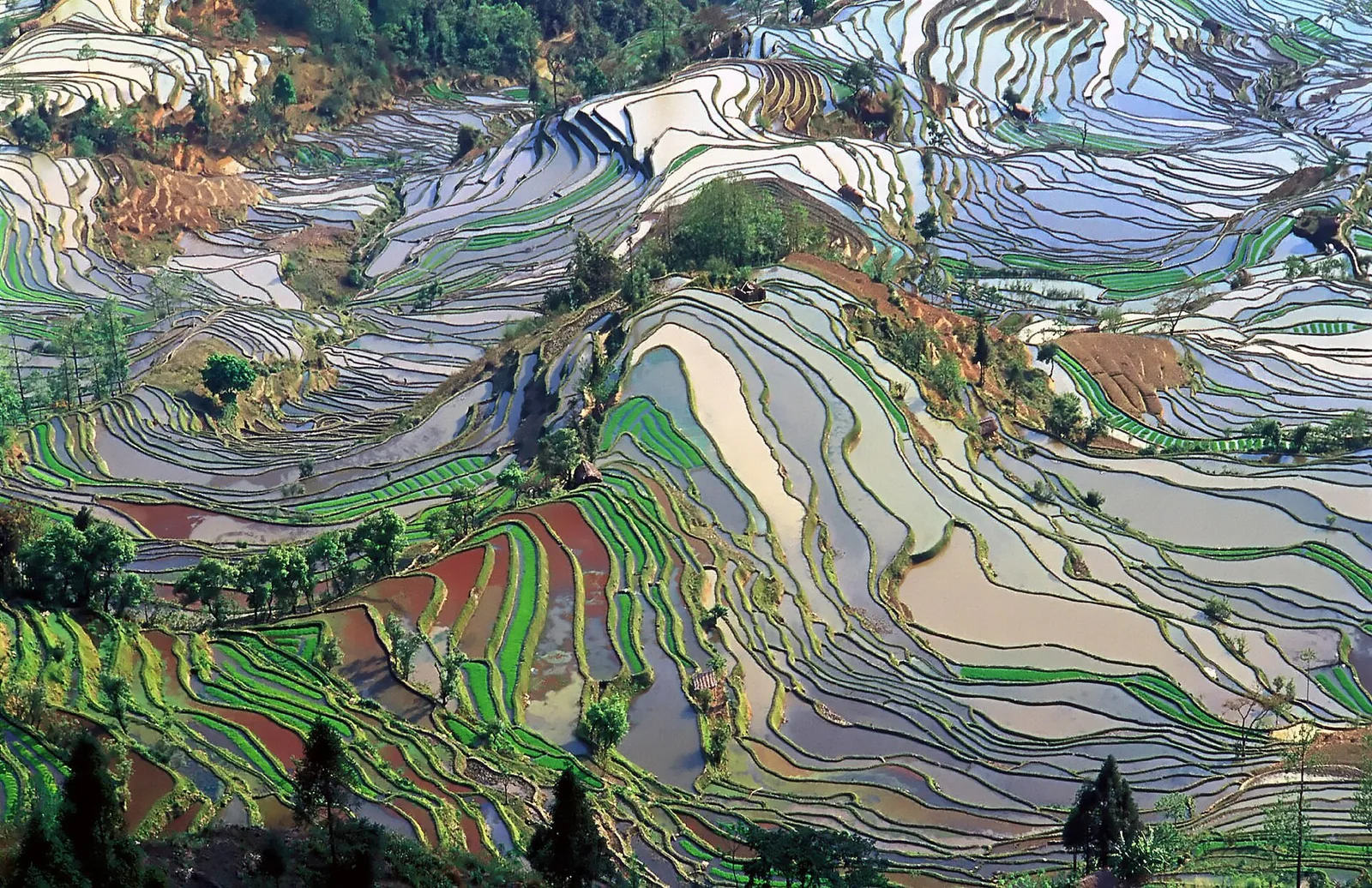
Yuanyang's terraces are not a single viewpoint but a whole mountain system: thousands of stepped paddies carved into ridges, worked by Hani, Yi, and other communities for generations. The UNESCO designation is deserved, but the experience depends heavily on season and weather. In the flooded months, the terraces become mirrors for sunrise and sunset. In the growing season, they are green and lush but less photogenic.
How the landscape works
The terraces follow the contour of the hills, fed by forest watersheds above and a network of channels that distribute water down the slopes. The Hani villages sit at the top of the system, close to the forest; the fields descend below. This is not scenery maintained for tourists — it is a working agricultural landscape, and you will see people carrying tools, tending buffalo, and repairing channels.
The main viewpoints — Duoyishu for sunrise, Bada for sunset, and Laohuzui for the classic terraced amphitheatre — are connected by a road that winds through the mountains. A driver is the most efficient way to move between them. The light changes quickly, and the difference between a clear morning and a cloudy one is enormous.
- Duoyishu at sunrise, when the terraces fill with reflected light
- Bada and Laohuzui in the late afternoon
- Hani village walks and markets
- The forest above the terraces, which feeds the whole system
Season and weather
The classic window is December–March, when the paddies are flooded and bare, creating the mirror effect. January and February are the most popular months, with cold mornings and clear skies. Mist is common; some travelers see nothing for days. Build in at least two mornings if photography is the goal.
The rainy season (June–September) turns the terraces green and the roads muddy. It is beautiful in its own way but not the postcard image. The shoulder months can be a good compromise: fewer crowds, mixed weather, and a more lived-in landscape.
- Two or three nights minimum for a chance at good light
- Mornings are cold in winter — bring layers
- Roads can be foggy and slow; do not book a tight onward connection
The village side
The terraces are the headline, but the villages are where the culture lives. Hani houses, mushroom-shaped granaries, and small markets are part of the landscape. Some villages have homestays; standards vary. If you stay locally, you contribute more directly to the community and get access to dawn viewpoints without a long drive.
Tourism here is less developed than in Dali or Lijiang, which is both an advantage and a practical challenge. English is limited, transport is best arranged in advance, and expectations should be modest. The reward is one of the most extraordinary agricultural landscapes in Asia, seen at the pace it was built for.
Highlights
- 01Duoyishu sunrise over flooded terraces
- 02Laohuzui's terraced amphitheatre
- 03Hani villages and markets
- 04The forest-and-water system above the fields
Getting there
- About 6–7 hours by road from Kunming, or 3–4 hours from Jianshui.
- Buses run to Yuanyang county town; from there, arrange a driver for the viewpoints.
- A private car is the most practical way to cover the scattered viewpoints.
Where to stay
Duoyishu or the nearby villages for sunrise access; Yuanyang town for more services.
Honest notes
Cloud and mist can hide the terraces for entire days.
Viewpoint tickets and transport add up; budget for a driver.
Some villages are poor and tourism benefits are uneven.
Best for
- + Photographers and landscape lovers
- + Travelers interested in agricultural systems and village life
- + People who can be flexible with weather
Not for
- − Travelers who need guaranteed views
- − Anyone with limited time or a tight road schedule
Routes through here