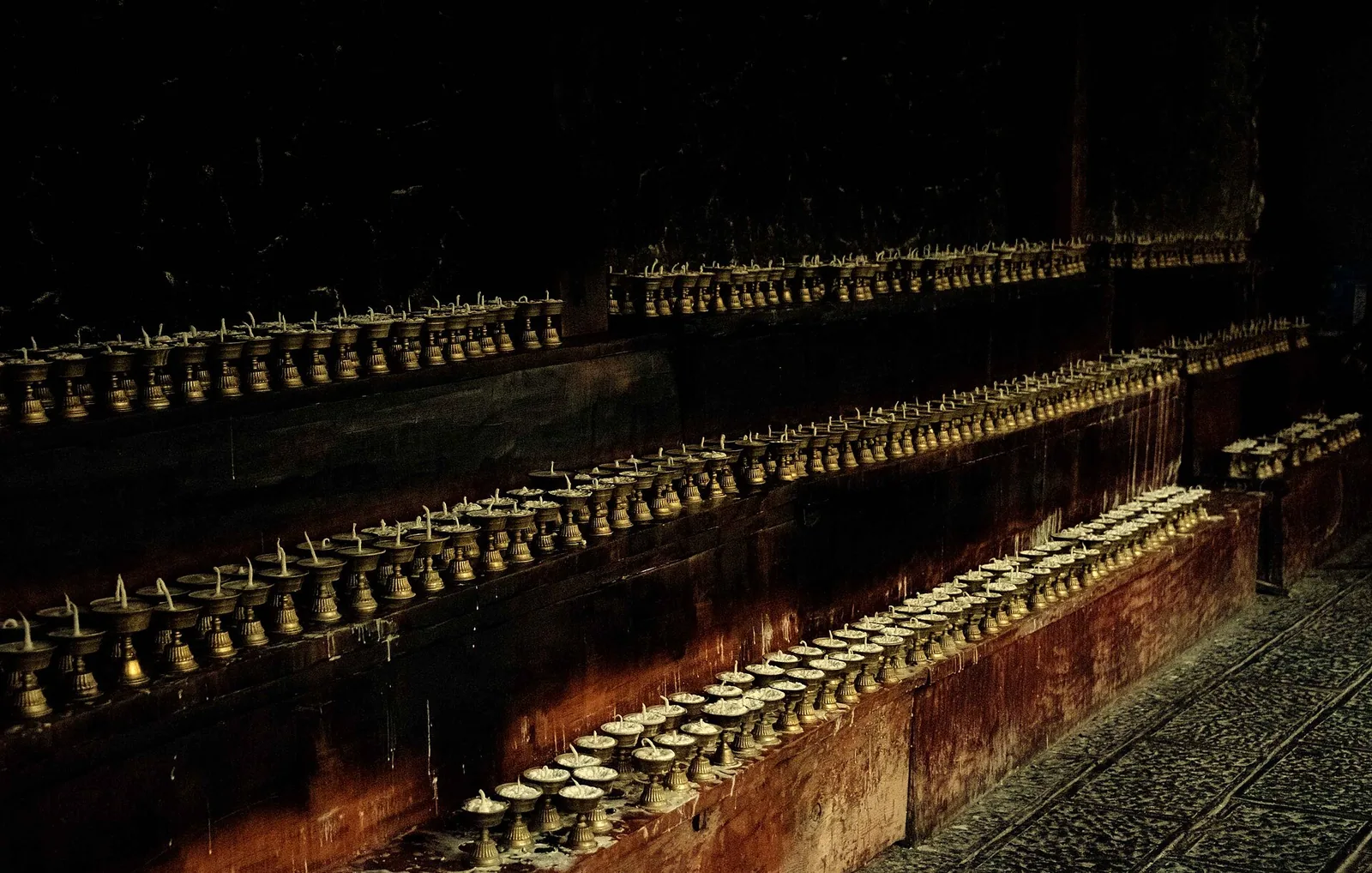
In northwest Yunnan, religion is not confined to monuments. It is in the prayer flags on a pass, the incense in a village temple, the old woman circumambulating a monastery, and the household shrine above a doorway. For travelers, the challenge is to observe without turning someone's practice into content.
What you will see
Songzanlin in Shangri-La is the largest Tibetan Buddhist monastery in Yunnan. Smaller monasteries and nunneries are scattered through the valleys. Naxi communities practice a blend of Dongba ritual, Buddhism, and local cosmology. Bai villages have temples to local deities as well as Buddhist halls.
Prayer flags, stupas, and mani stones mark passes and crossroads. Walk around stupas clockwise unless local practice says otherwise. Do not climb on prayer flags or move stones from cairns. These are not decorations.
- Remove shoes and hats in temple halls where required
- Ask before photographing monks, pilgrims, or ceremonies
- Walk clockwise around stupas and prayer wheels
Visiting a monastery well
Go in the morning, when monks and pilgrims are active. Dress modestly: covered shoulders and knees. Speak quietly. If a hall is closed, do not force a door. If a ceremony is in progress, stand at the back and do not use a flash. A small donation is appropriate where there is a donation box, but do not treat it as an entrance fee.
Photography rules vary. When in doubt, ask. Some monks are happy to talk; others are busy. Do not offer money for a photograph. If you want to learn, visit the monastery museum or ask a guide who has a relationship with the community.
The honest trade-off
Religious sites are not theme parks, and tourism has changed them. Some monasteries are crowded and commercial; others are quiet and underfunded. Your visit can support conservation or it can add to the pressure. The difference is mostly in behavior: dress, quiet, and respect.
Do not expect to understand everything. Theologies and local practices are complex, and a short visit cannot do them justice. Ask open questions, accept partial answers, and leave space for the people who actually practice there.